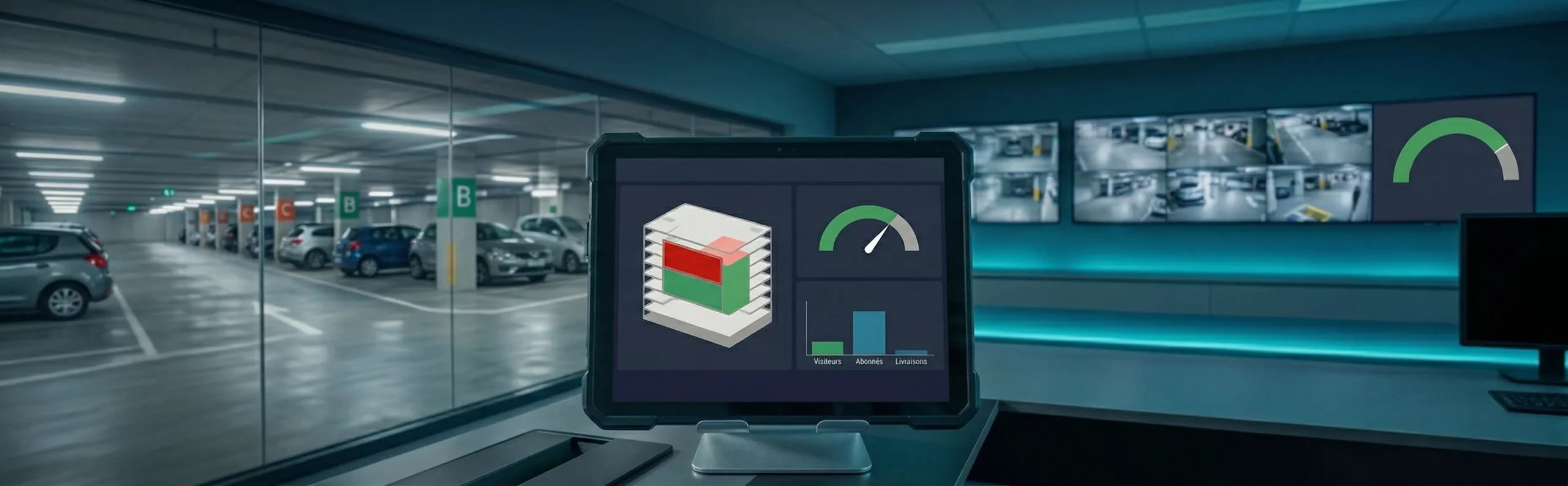
The effectiveness of a parking infrastructure relies on the precision of its steering. For an operator, the challenge is no longer just collecting data, but isolating the KPIs capable of validating or adjusting an operational strategy.
Isolating, analyzing, and synthesizing these indicators allow for a transition from raw observation to precise decision-making, tailored to the specific constraints of each site.
Useful data: moving from figures to actionable KPIs
The major challenge in operations lies in the clarity of information. A massive volume of data without hierarchy remains unusable. The role of reporting is to extract clear signals to correct malfunctions: localized saturation, persistent vacancy, or non-compliant zone usage.
The objective is to transform a mass of heterogeneous information into a true decision-making dashboard. This approach allows a shift from passive management to proactive steering, where every decision is backed by a measurable field reality.
Three pillars for structuring performance analysis
To optimize a parking asset, analysis must focus on three fundamental metrics, cross-referenced according to the site’s needs:
- Sectorized occupancy rate: This is not about measuring a global rate, but mapping real usage by zone or level. This precision identifies structural vacancy areas that penalize overall yield or fluidity.
- Space rotation: This is the key indicator of site accessibility. Low rotation may signal the presence of “buffer vehicles” or an ill-suited access policy, preventing the arrival of new flows.
- Average stay duration: Analyzing parking time by user profile (visitors, subscribers, deliveries) ensures that the use of the parking facility aligns with its intended purpose.
Adaptability: reporting aligned with your constraints
The strength of a modern management system lies in its ability to be configured according to the operator’s priorities. Each site has its own “rules of the game”:
- An industrial site will prioritize security and the fluidity of logistical flows.
- A corporate building will seek to optimize space allocation between employees and visitors.
- A commercial space will focus on high rotation to maximize the number of customers welcomed.
Reporting must therefore be bespoke. Being able to set your own indicators and alerts ensures that the tool adapts to the manager’s needs, and not the other way around. This flexibility is what allows for the identification of a drift or a valuation opportunity in just a few clicks.
Leveraging the site’s residual capacity
Historical data analysis often reveals residual capacity: empty spaces at predictable times or days. For an owner or manager, this visibility is a direct lever for valuation.
Identifying these pools of available spaces allows for concrete solutions: space sharing with partners, opening to new audiences during specific slots, or reallocating zones for new services. Reporting then becomes a profitability tool, transforming a management constraint into a lever for real estate performance.
A dual approach: responsiveness and strategy
Finally, effective steering combines two indispensable timelines:
- Real-time: For immediate flow regulation and incident resolution.
- Historical analysis: To identify underlying trends, adjust budgets, and plan site evolutions.
Having precise and sectorized indicators allows for total control over infrastructure. This mastery, supported by a clear reading of the data, is what guarantees long-term performance and fluidity for a parking site today.